ESR-REIT’s A$288.6M Melbourne Logistics Buy: Divestment Proceeds Redeployed Within a Week, +4.3% DPU Accretive, Gearing Back Up to 41.9%
One week after completing the last of its S$439.1 million Singapore divestments, ESR-REIT has agreed to buy five freehold Melbourne logistics assets for A$288.6 million (≈S$258.4M) — a 1.9% discount to JLL’s valuation net of adjustments, +4.3% DPU…
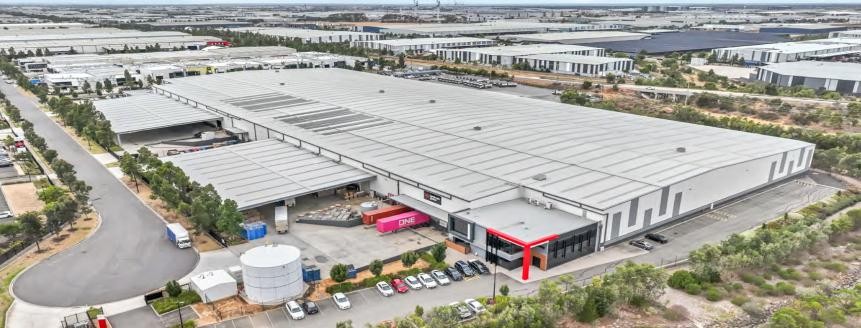
ESR-REIT has agreed to acquire five institutional-grade freehold logistics properties in Melbourne for a purchase consideration of A$288.6 million (approximately S$258.4 million) — announced on 7 July 2026, exactly one week after the final asset in its S$439.1 million Singapore divestment programme completed on 30 June. Net of an estimated A$11.8 million completion adjustment for unutilised rent incentives and a rental guarantee, the price lands at A$276.8 million (≈S$247.9 million), a 1.9% discount to JLL’s 26 June valuation excluding the guarantee. The deal is expected to be +4.3% DPU accretive on a FY2025 pro forma basis, will be fully debt financed at completion, and is targeted to close in 3Q 2026 following Australian FIRB approval.
The portfolio
The five assets sit in Melbourne’s established western and south-eastern industrial precincts: 15 & 33 Archer Road, Truganina (30,157 sqm, the largest by area); 4-12 Doriemus Drive, Truganina (22,840 sqm); 64 West Park Drive, Derrimut (20,337 sqm); and two Keysborough assets — 39 Naxos Way (20,472 sqm) and 58-76 Naxos Way & 68 Atlantic Drive (28,605 sqm, the largest by price at A$75.7 million). Total GLA is 122,411 sqm, average building age roughly 11 years, all freehold. Seven tenants anchor the rent roll, led by CEVA Logistics (across both Truganina assets), Silk Logistics and Nick Scali, alongside FDM, Rubies, Fletcher Insulation and Siluan. The portfolio WALE is a short 3.2 years — pitched as a feature, not a bug: Colliers puts current in-place net rents 12–17% below market, so near-dated expiries are reversion optionality, complemented by built-in escalations of 3.0–3.5% per annum on the longer leases. First-year NPI of A$16.0 million prices the deal at a 5.5% yield on purchase consideration. The vendor entities across all five sale-and-purchase agreements are trusts held under Australand Property Holdings — Frasers Property’s Australian platform — in what the Manager describes as a competitive open-market sales process.
The recycle loop closes
The timeline is the story. ESR-REIT announced the eight-asset S$338.1 million industrial divestment on 15 December 2025 and the S$101.0 million Changi hotel strata sale on 30 January 2026; the hotel completed on 27 March, and the eighth and final industrial asset completed on 30 June. Seven days later, the proceeds have a destination. The divested Singapore assets carried a weighted average remaining land lease of just 22.4 years with dated specifications; the replacements are freehold. Post-completion, the portfolio’s weighted average land lease tenure extends from 44.9 to 47.7 years and the freehold share of assets rises from 19.3% to 23.5% — the most direct answer yet to what CEO Adrian Chui calls the trust’s “land lease decay conundrum.” Australia moves from 12.7% to 15.5% of portfolio rental income, with Singapore staying above 75%.
What the +4.3% is measured against
The accretion arithmetic deserves a careful read. The +4.3% is computed against the post-divestment pro forma DPU of 20.091 Singapore cents — not FY2025’s actual 21.914 cents. After both the divestments and the acquisitions, pro forma FY2025 DPU is 20.953 cents, still about 4.4% below the pre-divestment book. The acquisition repairs most of the divestment drag; it does not erase it. The Manager’s framing — minimising the DPU timing mismatch of portfolio repositioning — is fair, and the one-week divest-to-deploy turn is genuinely fast, but the baseline matters for anyone modelling the distribution.
Balance sheet: the gearing round trip
The total acquisition outlay of A$303.0 million (≈S$271.3 million) — net consideration plus a A$2.9 million acquisition fee to the Manager and A$23.3 million of stamp duty and other costs — is funded from divestment proceeds and new SGD debt at a pro forma all-in cost of 2.49%, with no new units issued. Aggregate leverage, which the divestments had walked down from 43.4% to 38.5%, climbs back to 41.9% pro forma. The Manager may issue up to S$175.0 million of subordinated perpetual securities to partially repay the drawdown, which would restore leverage to 38.5% — at the cost of accretion falling to +1.3%. NAV per unit slips 0.8% to S$2.53. Post-completion, 31.7% of total assets carry FX exposure, with AUD investments 32% AUD-funded and JPY 97% JPY-funded. At 13.4% of market capitalisation under Rule 1006(c), the deal is a discloseable transaction — no unitholder vote required.
The Keysborough vacancy
The one asset that isn’t full is 39 Naxos Way, Keysborough, at 46% occupancy. The vendor provides a one-year rental guarantee of approximately A$2.5 million covering the vacant 54%, adjusted in the purchaser’s favour at completion — so the money is in hand upfront rather than owed. With the guarantee, financial occupancy reads 100%; without it, physical portfolio occupancy is 90%. It also explains the deal’s widest single-asset pricing gap: the two Keysborough assets were struck at 2.7% and 4.8% below valuation respectively, versus near-par for the three western-corridor assets. The guarantee buys the leasing team twelve months — in a Melbourne south-east market where Colliers’ own numbers say rents are running ahead of in-place levels, that is a reasonable bet, but it is the execution item to watch at the FY2026 results.