OUE REIT to Divest Crowne Plaza Changi Airport for S$500M — 1.3% Above Valuation, ~S$15M Below Book, Sold to Its Own Sponsor’s JV with Tokyo Century Ahead of the 2028 Contract Cliff
OUE REIT (SGX: TS0U) has proposed to divest Crowne Plaza Changi Airport, its 575-room airport hotel, for S$500.0 million to a joint venture 51%-controlled by its own sponsor OUE Limited and 49% by Japan’s Tokyo Century. The price is a 1.3% premium to…
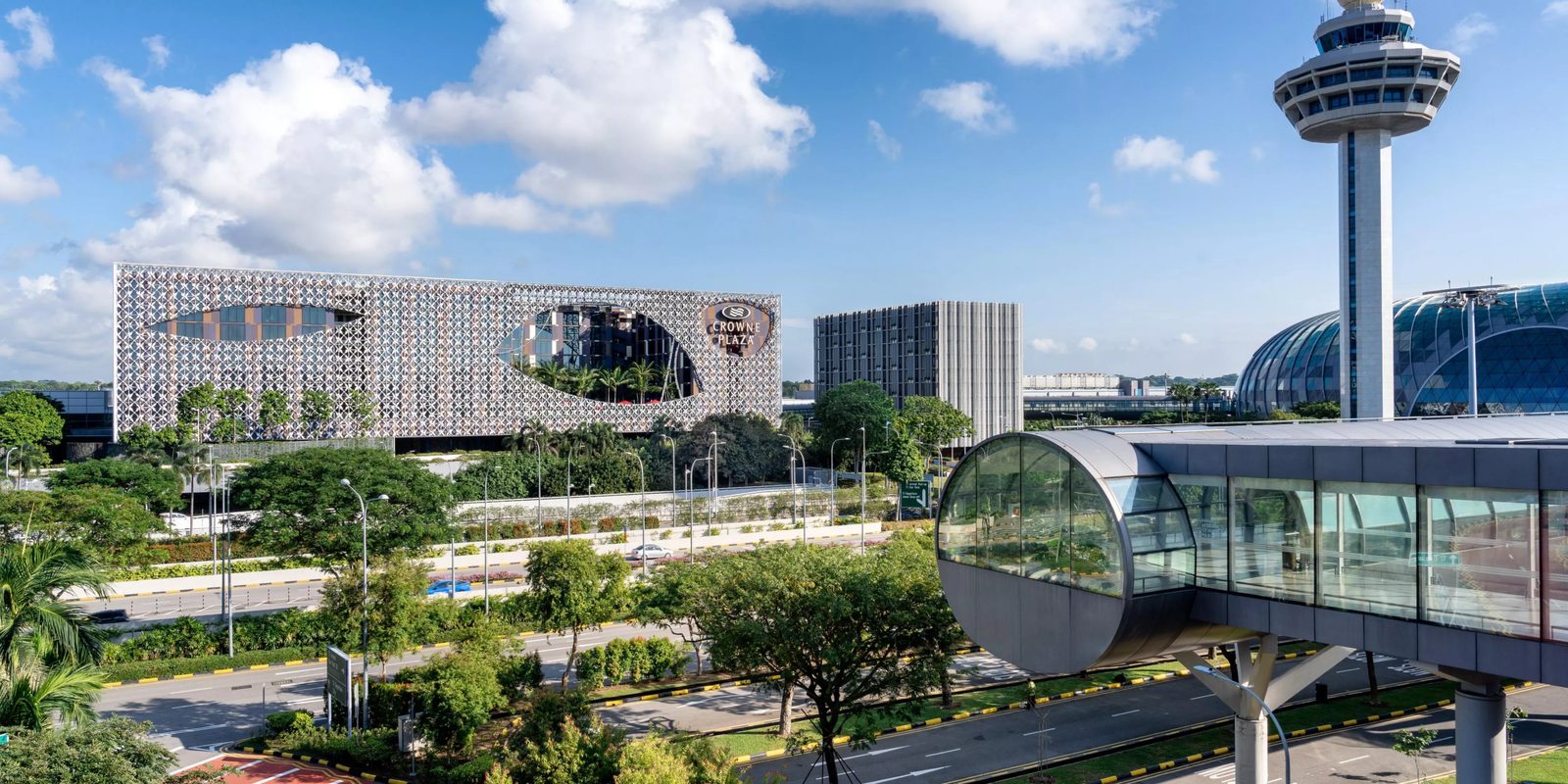
OUE REIT (SGX: TS0U) has proposed to divest Crowne Plaza Changi Airport, its 575-room airport hotel, for S$500.0 million to a joint venture controlled by its own sponsor, OUE Limited. The price is a 1.3% premium to the average of two independent valuations — but a roughly S$15 million deficit to the asset’s S$511.0 million book value — and because the buyer is a sponsor vehicle, the deal is an interested-person transaction that must clear a vote of independent unitholders.
Announced on 25 June 2026, the Proposed Divestment sees DBS Trustee Limited, as trustee of OUE REIT’s wholly-owned OUE Hospitality Sub-Trust, sell the leasehold estate on which the hotel sits to OUE TC TM Pte. Ltd., trustee-manager of a newly formed trust that is 51%-owned by OUE Limited and 49% by Japan’s Tokyo Century Corporation. A put-and-call option agreement was signed on 24 June 2026; OUE REIT will seek approval at an extraordinary general meeting (EGM) in the third quarter of 2026, with completion targeted for the fourth.
The asset, and three valuations
Crowne Plaza Changi Airport, at 75 Airport Boulevard, is an upper-upscale hotel directly connected to Changi Airport Terminal 3 and a short walk from Jewel. Built in two phases — a 332-room main wing (2008) and a 243-room extension (2016) — it is managed by InterContinental Hotels Group (IHG) and has been named the World’s Best Airport Hotel at the Skytrax awards for eleven straight years. OUE REIT holds it on a leasehold running to 29 August 2083, roughly 57 years remaining, over about 440,395 square feet of gross floor area.
At S$500.0 million, the price works out to about S$870,000 a room. Three independent valuations frame it: Cushman & Wakefield, engaged by the trustee, valued the property at S$492.0 million; JLL, engaged by the manager, at S$495.0 million — an average of S$493.5 million, which the consideration tops by 1.3%. The buyer’s own valuer, Savills, landed at exactly S$500.0 million. The honest counterweight is book value: the hotel was carried at S$511.0 million as at 31 December 2025, so the sale crystallises a net deficit of about S$15.0 million against book, even as it prints a premium to the latest valuations.
A sale to its own sponsor
The counterparty is the spine of the story. OUE Limited (SGX: LJ3) is OUE REIT’s sponsor, its 48.98% controlling unitholder, and the owner of its manager; it will hold 51% of the buying joint venture, and the hotel’s master lessee is already an OUE subsidiary. That makes the purchaser an associate of OUE, and the divestment an interested-person transaction (IPT) under the SGX-ST listing rules and an interested-party transaction under the property-funds regime. At S$500.0 million, the deal equals 16.2% of OUE REIT’s S$3,092.9 million net tangible assets (NTA) — well above the 5% threshold — so it requires the approval of independent unitholders at the EGM, with OUE and its associates abstaining. Deloitte Singapore SR&T Corporate Finance is the independent financial adviser, and its opinion will appear in the circular.
Why now: ahead of the 2028 cliff
The timing is the clearest part of the rationale — and it cuts both ways. Both the IHG hotel-management contract and the master lease that currently underpins the hotel’s income expire in 2028. Selling now lets OUE REIT offer a buyer vacant possession and full rebranding flexibility, while shedding three things it would otherwise carry: the substantial capital expenditure of a room renovation and rebrand, the operational downtime that would dent distributions, and the loss of the master lease’s minimum-rent floor that today cushions the trust against tourism shocks. The mirror image is that the upside OUE REIT is foregoing — a refurbished, rebranded hotel riding the build-out of Changi’s Terminal 5 in the mid-2030s — is precisely what the sponsor-led joint venture is buying. The JV plans an asset enhancement initiative (AEI) and intends to fund up to S$325 million of the purchase with debt secured on the property.
The DPU lift is one-off; the deleveraging is durable
OUE REIT will take net cash proceeds of about S$498.5 million and intends to return S$20.0 million of it to unitholders as a special distribution, paid evenly across the two years after completion. That is what drives the headline — pro forma FY2025 distribution per unit (DPU) rises 5.8%, from 2.23 to 2.36 cents, lifting yield from 6.2% to 6.6%. But the special distribution is doing the work: strip it out and DPU actually slips to 2.18 cents, because the trust is parting with a hotel that contributed S$22.5 million of net property income, about 10.2% of the total. The special distribution is a return of capital, not recurring rent. The manager does not frame it otherwise: chief executive Han Khim Siew called this an opportune time to crystallise the hotel’s value ahead of substantial capital-expenditure and income risks, and has characterised the headline accretion as mechanical — an accurate description, since it rests on the two-year special distribution rather than on the underlying portfolio.
The more durable gain is on the balance sheet. Applying the proceeds to debt repayment, aggregate leverage falls from 41.5% to 36.6% as at 31 March 2026 — close to five percentage points of fresh headroom — while NAV per unit holds at about S$0.55. That is the structural prize: a deleveraged trust with capacity to redeem perpetual securities, buy back units, or fund accretive acquisitions.
The same recycling playbook
OUE REIT casts the move as the next step in a ‘Phase 3’ capital-recycling strategy aimed at closing the gap between its unit price and NAV. The template is recent: in December 2024 it exited the ageing, short-leasehold Lippo Plaza Shanghai for S$357.4 million, then in March 2026 deployed into a 19.9% stake in 180 George Street (Salesforce Tower) in Sydney at about S$319.8 million — a new freehold tower on a 5.8% initial yield. After this divestment, roughly 94.3% of the portfolio sits in Singapore and the office segment supplies more than 54.3% of revenue: a more Singapore-centric, office-anchored book.
The read
For OUE REIT the logic is coherent — crystallise a mature hotel near the top of its valuation, sidestep a looming capex-and-rebrand cycle, deleverage hard, and hand unitholders a cash sweetener. The questions independent unitholders will weigh are whether S$500 million — above the latest valuations but below book — fully captures the asset’s post-2028, post-AEI, Terminal-5 potential, and whether selling that upside to the sponsor, on a vote in which the sponsor abstains, is the right trade. Watch the independent adviser’s fairness opinion in the circular, and the EGM in the third quarter — that is where the deal is decided.
Source: OUE REIT announcement, investor presentation and press release, and OUE Limited’s joint-venture announcement and OUE–Tokyo Century press release, all dated 25 June 2026 (SGXNET). PropertyAtlas.sg analysis with TKRE Research.