The 0.0% NPI print is the master-lease structure working as designed — 54.3% of GRI on contracted step-ups means the trough between reviews looks flat, while three forward catalysts (David Jones Perth Aug 2026, Wisma Atria façade mid-2026, Toshin June 2028) anchor the FY26/27-FY28/29 income line
Starhill Global REIT reported 3Q FY25/26 (quarter ended 31 March 2026) on 29 April 2026 with gross revenue +0.7% to S$47.9m and net property income flat at S$37.9m (0.0% YoY) on portfolio committed occupancy of 96.4% — a headline that taken in isolation…
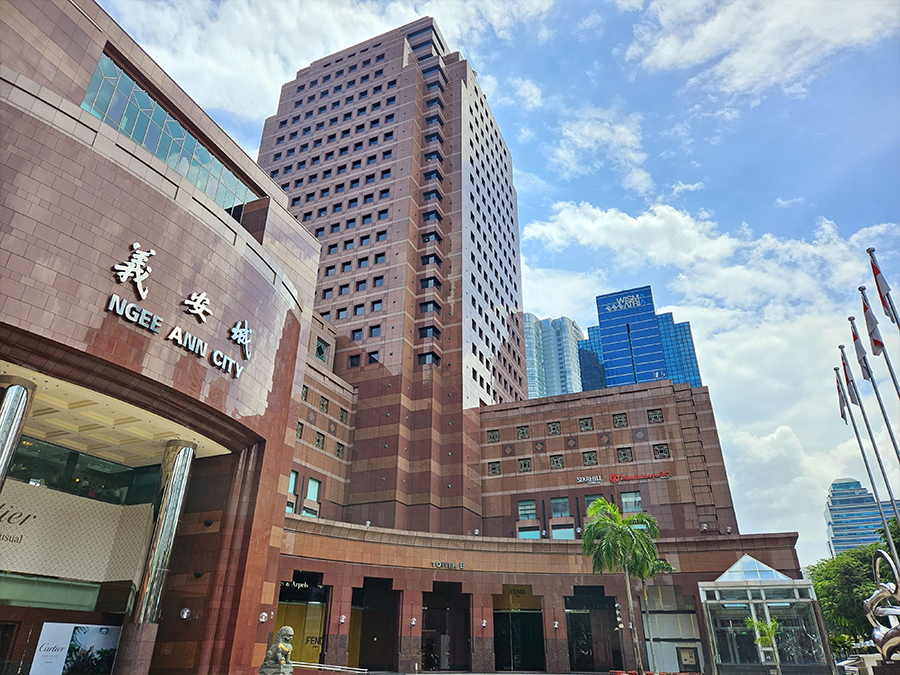
Starhill Global REIT 3Q FY25/26 (quarter ended 31 March 2026, reported 29 April 2026) delivered Gross Revenue of S$47.9m (+0.7% YoY) and Net Property Income of S$37.9m (0.0% YoY) — a headline print that, taken on its own, looks like another flat quarter. But flat is the wrong frame for SGREIT. Underneath the print, 54.3% of gross rental income is locked in master and anchor leases with periodic rent reviews — Toshin at Ngee Ann City (renewed to 2043, next review June 2028), The Starhill KL (2038), Lot 10 KL (2028), Myer Adelaide (2032 with annual reviews) and David Jones Perth (2032 with three-yearly upward-only reviews, next review August 2026). The "0.0% NPI" print is exactly what this design produces in a quarter where the actively-managed 45.7% portion is doing all the work: Ngee Ann City actively-managed space and Lot 10 contributing positively, A$ and RM appreciation lifting offshore translation, partially offset by lower contribution from Wisma Atria retail and Myer Centre Adelaide office plus the 13-strata-unit divestment at Wisma Atria Office completed through 9M FY25/26. Strip the divestment effect and 3Q NPI was +1.2% YoY. Six insights beyond the headline.
Gross Revenue S$47.9m (+0.7% YoY vs S$47.6m). NPI S$37.9m (0.0% YoY); ex-divestment +1.2% YoY. Property breakdown — Ngee Ann City S$17.0m revenue (+S$0.4m) / S$14.0m NPI (+S$0.5m); Wisma Atria S$12.5m / S$9.6m (each down on lower retail contribution and the strata-unit divestment); Australia properties S$10.0m / S$6.5m (A$ tailwind); Malaysia properties S$7.9m / S$7.7m (RM tailwind plus Lot 10 step-up); Others (Tokyo + Chengdu) S$0.5m / S$0.1m. Portfolio committed occupancy 96.4% (vs 94.6% at 30 June 2025), with retail portfolio at 97.3%. By geography: Singapore 99.6%, Australia 91.6% (recovered from 86.9%), Malaysia / Japan / China each at 100%. WALE 7.3 years by GRI (7.2 by NLA). FY25/26 expiring leases just 4.8% of GRI. Capital — total debt S$1,020m, gearing 35.5%, interest cover 3.0x, all-in cost 3.65%, 80% fixed/hedged, weighted average debt maturity 3.5 years, unencumbered assets ratio 84%. Fitch BBB Stable.
54.3% of gross rental income is contracted on master and anchor leases with periodic rent reviews built in. This is the structural feature that distinguishes SGREIT from almost every other Singapore-listed retail REIT, and it is the lens through which every line in this deck must be read. The master-lease block is composed of five contracts. Toshin at Ngee Ann City — by some distance the largest single income contributor in the entire portfolio — has been renewed and now runs to June 2043, with the next rent review falling in June 2028. The Starhill in Kuala Lumpur runs to December 2038 with periodic step-ups embedded. Lot 10 in Kuala Lumpur runs to June 2028. The Myer anchor at Myer Centre Adelaide expires in 2032 with annual rent reviews — note the cadence — providing the most frequent step-up clock in the portfolio. David Jones at Perth runs to 2032 (assuming the fifth five-year renewal option is taken) with a three-yearly upward-only review mechanic; the next review lands in August 2026, the quarter after this one. The function of the master-lease block is two-fold. First, it underwrites a baseline level of GRI that does not move with month-to-month leasing decisions, vacancy churn or tenant negotiations, which is why the portfolio can post 7.3-year WALE and only 4.8% of leases expiring in FY25/26 — both numbers materially better than the actively-managed-only retail peer set. Second, the periodic step-up mechanic captures rental growth at scheduled intervals rather than continuously, which produces the "flat for several quarters then a step" earnings shape that SGREIT has been delivering for years. The 3Q FY25/26 print of 0.0% NPI is not stagnation — it is the trough between step-ups, and it is exactly what the structural design is supposed to produce in a transitional quarter.
Of the five master-lease contracts, the one that matters most to FY27/28 and FY28/29 income visibility is the Toshin renewal at Ngee Ann City. Ngee Ann City contributes S$17.0m of the quarter's S$47.9m gross revenue — roughly 35% of the entire portfolio's top line, and the largest single property by income in the portfolio. The master lease was just renewed to 2043, removing 17 years of tenure-extension uncertainty in one stroke. But the economically meaningful event is not the renewal itself; it is the next scheduled rent review, which falls in June 2028. Between now and that review, two factors are compounding in SGREIT's favour. First, Singapore Orchard Road prime retail rents grew +2.1% YoY in 1Q 2026 per CBRE, with the manager flagging "limited new supply over the next three years" and "resilient tourism and consumer spending" as the supporting demand drivers. Second, Singapore tourism is on a clear upward path — 16.9m international visitor arrivals in 2025 (+2.3% YoY), with STB's 2026 forecast of 17–18m IVAs and S$31.0–32.5bn in tourism receipts. These two trends, layered across 27 months of compounding before the review, set up the June 2028 review as the most material upward step-event scheduled anywhere in the portfolio. The size of that step is what FY28/29 distributable income depends on — and it is a reviewable rather than a market-clearing variable, which means execution risk is concentrated in the manager rather than the broader market. For investors building a multi-year IRR framework on SGREIT, the Toshin June 2028 review is the single calendar event around which the case is constructed.
The headline NPI movement of 0.0% YoY is presented in the deck without softening, and the manager has explicitly disclosed the divestment offset. Reported NPI was S$37.9m versus a prior-year S$37.9m (rounded). Stripping the divestment effect, NPI would have grown 1.2% YoY. The driver is the staged divestment of 13 strata units in Wisma Atria Office across the nine months ended 31 March 2026, reducing SGREIT's share value of the Wisma Atria strata lots to 64.34%. Two readings of this are available, and both are credible. Sympathetic read: clearing thirteen office strata at a moment when Singapore Grade A Core CBD rents are growing +2.9% YoY and Grade B +4.0% YoY is a clean monetisation of the office component of an asset whose retail and office sit on the same strata title — recycling capital out of office (where SGREIT is sub-scale at 13.5% of gross revenue) into the more strategic retail blocks where SGREIT has scale, tenancy depth and the master-lease structure that defines its identity. Critical read: 13.5% of revenue is already a structurally low office exposure, the unencumbered assets ratio is already at 84%, and selling office strata into a rising market may have given up future income optionality more cheaply than necessary. Both readings agree on the operating-line consequence: 1.2% underlying growth is the genuine number, 0.0% reported is the optical drag, and the 120-basis-point gap is the price of capital recycling. This is precisely the same playbook ESR-REIT and MIT executed in their 1Q FY25/26 prints at a much larger scale — flat-or-declining headline, positive same-store underneath, divestment income loss pending redeployment. SGREIT's version is smaller and slower but structurally the same trade.
4. WISMA ATRIA RETAIL IS THE ONLY SOFT CELL — AND THE FAÇADE PROJECT IS THE MANAGER'S DIAGNOSIS:
Wisma Atria is the lone disappointment in the portfolio. Year-to-date 9M FY25/26 shopper traffic was −0.8% YoY and tenant sales were flat at 0.0% YoY — both numbers underwhelming in a Singapore quarter where the retail sales index (excluding motor vehicles) was +11.2% YoY in February 2026, advance 1Q 2026 GDP was +4.6% YoY, and Orchard Road prime retail rents grew +2.1%. Singapore retail occupancy at SGREIT remains high at 99.6%, so this is a spend-per-visitor and visitor-conversion problem rather than a supply or vacancy problem. The manager's response is the S$2.2m façade upgrading project at the Orchard Road-facing Level 2 and Level 3 units, which commenced in March 2026 and is targeted for completion by mid-2026 subject to authority approvals. The scope — structural provisions for future double-storey façade panels, upgraded covered-corridor lighting, recladding of corridor-side columns — is consistent with a diagnosis that Wisma Atria's external presentation has fallen behind the more recently refreshed Orchard Road competition (ION, Ngee Ann City's own façade, Paragon and Takashimaya's interior refreshes). The investment case implication is straightforward: Wisma Atria is operationally the smallest of the three Singapore master-lease anchors, contributes ~26% of Singapore revenue, and is the asset most exposed to actively-managed leasing economics rather than fixed step-ups. If the façade project lifts traffic conversion in 2H FY26/27 — the first full reporting period after completion — that asset goes from drag to neutral. If it does not, the manager is left with a structural under-performer in a portfolio otherwise built around stability. The FY27/28 prints will tell.
The Australia commentary in the macroeconomic outlook section is doing more work than it might first appear. CBRE's 1Q 2026 Australia retail data prints Adelaide super-prime CBD retail net effective rents at +5.5% YoY, and Perth at +10.0% YoY — the latter materially higher than any market reference point in the deck for any other geography. Two SGREIT-specific events sit downstream of this. First, the David Jones Perth anchor lease has its next three-yearly upward-only rent review in August 2026 — one quarter after this print. Going into a +10% rent-effective market with an upward-only mechanic produces an asymmetrically positive expected value on that single rent reset; the only risk is execution slippage, not direction. Second, Myer Centre Adelaide's anchor lease has annual rent reviews built in, meaning the +5.5% Adelaide market reference already begins to feed the FY26/27 income line. Underneath the master-lease economics, the actively-managed Australia component is also recovering — Australia portfolio occupancy moved from 86.9% at 30 June 2025 to 91.6% at 31 March 2026, a 470-basis-point recovery in nine months that the manager attributes in part to the new lease at Edith Cowan University CBD campus driving Perth foot traffic and to the ongoing repositioning of Myer Centre Adelaide's lower-ground food court (A$6m project, completion end-2026, +1,000 sqft NLA from new food kiosks). Australia accounted for 21.0% of 3Q FY25/26 gross revenue — disproportionate to its 12.9% share of asset value — and is the geography where the master-lease step-up cycle, the underlying rent-effective trajectory and the operational recovery line are all currently aligned. This is the segment most likely to surprise to the upside through FY26/27.
Total debt sits at S$1,020m against a gearing of 35.5% — comfortably 1,450 basis points below the 50% MAS limit and one of the more conservative gearing positions in the Singapore retail-REIT peer set. All-in cost of debt is 3.65%, the fixed/hedged ratio is 80%, weighted-average debt maturity is 3.5 years, and Fitch maintains a BBB Stable rating. Interest cover is 3.0x, falling to 2.7x under a 10% EBITDA decline and 2.3x under a 100bps base-rate increase — neither stress level is ratings-threatening but the rate-stress band narrows the headroom enough to argue against further leverage in the current cycle. The capital event of the quarter is the April 2026 signing of S$70m and A$70m six-year unsecured sustainability-linked facilities, both expected to be drawn in FY26/27 mainly for refinancing existing debt. Post the refinancing, the manager confirms available long-term committed and undrawn RCF lines of S$350m, sufficient to cover all maturing debt out to FY28/29. The tail-risk year is FY29/30 — peak maturity at 25% of total debt and 9% of total assets, with S$160m of RM500m MTN, S$100m of S$100m term loan, and the bulk of the S$200m FY30/31 term loan all clustered in or around that window. The Manager's S$100m perpetual securities issued in October 2025 — classified as equity, first distribution rate reset on 10 October 2030 — sit outside this debt picture but the reset itself is a known event-risk for FY30/31. The structural read on capital: SGREIT has used its BBB rating and conservative gearing to buy long-dated, hedged, low-cost capital that is structurally compatible with a master-lease income shape. The only forward variable is whether the FY29/30 refinancing window can be navigated at margins comparable to the current 3.65% all-in — a question that depends more on Singapore base rates and SGREIT's rating trajectory in 2028-29 than on anything visible in this quarter.
Portfolio asset value of approximately S$2.8bn is split 69.1% Singapore, 16.0% Malaysia, 12.9% Australia and 2.0% Others (Tokyo and Chengdu) by asset value, against a 3Q gross revenue split of 61.5% Singapore, 21.0% Australia, 16.5% Malaysia, 1.0% Others — Australia is over-indexing on revenue versus its share of asset value, while Singapore is under-indexing, both consistent with the master-lease step-up cycle currently being more active in Australia than in Singapore. Sector mix is 86.5% retail and 13.5% office by 3Q gross revenue. The China Property in Chengdu, which was the portfolio's tail-risk asset coming out of FY24/25, has been fully relet — the replacement tenant (a Chengdu interior design and renovation company) commenced fit-out in March 2026 and is targeted to begin trading by June 2026, restoring China occupancy to 100% with the income line beginning to flow in 4Q FY25/26. YTL Group remains the strategic shareholder at approximately 37.9%, providing the cross-listing into Bursa Malaysia (FBM KLCI component) and the sponsor anchor for the Malaysian master tenancy structure. Income visibility through FY26/27 is supported by 4.8% of GRI expiring in FY25/26 and 10.2% in FY26/27, both below the 12-15% per-year level that would normally raise leasing-execution risk for an actively-managed retail portfolio of this size.
Starhill Global REIT 3Q FY25/26 is a quarter where a flat headline is the structural design working as intended. 54.3% of GRI sits on master and anchor leases that step up at scheduled intervals rather than continuously, and the trough between step-ups is what produces the 0.0% NPI print. Strip out the deliberate office-strata divestment and underlying NPI grew 1.2% YoY. Three forward catalysts converge on FY26/27–FY28/29 income visibility: the David Jones Perth review in August 2026 (into a +10% rent-effective market), the Wisma Atria façade reopening in mid-2026 (the manager's response to YTD soft traffic), and the Toshin Ngee Ann City rent review in June 2028 (anchored on +2.1% Orchard Road prime growth and 17–18m IVA tourism trajectory). The capital structure — 35.5% gearing, BBB Stable, 80% fixed/hedged, 3.65% all-in, S$350m undrawn RCF post-April-refinancing — is configured for a master-lease income shape rather than a growth-acquisition shape, which is the right configuration for the FY26/27–FY28/29 step-up window and the FY29/30 maturity peak that ends it. For investors weighing SGREIT against the broader Singapore REIT peer set, the question is not whether 3Q FY25/26 was a strong quarter — it was a designed quarter — but whether the master-lease step-up calendar through to mid-2028 prints at the upper or lower end of the rent-effective ranges currently visible in CBRE's prime retail data. The Toshin review will answer it.