Centurion Accommodation REIT 1Q 2026: Two-Of-Two Prospectus Beat With Revenue +2.7% / NPI +2.4% / All Three Geographies Above Occupancy Forecast — But Aggregate Leverage Walked From 22.1% To 31.0% In Ninety Days On A$345M Sydney Acquisition, Hedge Ratio Rebuilt From 55.8% To 71.7% Across The Reporting Window
CAREIT's 1Q 2026 print, released 5 May 2026, marks the second reporting period since the REIT's 25 September 2025 SGX listing — and the second consecutive prospectus beat. Gross revenue of S$52.5M came 2.7% ahead of forecast, NPI of S$37.5M came 2.4%…
Centurion Accommodation REIT delivered a clean double beat in its second reporting period since SGX listing, with 1Q 2026 gross revenue of S$52.5 million coming in 2.7% above prospectus forecast and net property income of S$37.5 million printing 2.4% ahead. The outperformance ran across all three operating geographies — PBWA Singapore at 94.0% occupancy versus 93.1% forecast, PBSA United Kingdom at 99.0% versus 97.4%, and PBSA Australia at 97.5% versus 96.7%. Beneath the headline beat, three structural moves frame the trajectory: the A$345 million EPIISOD Macquarie Park acquisition pulled aggregate leverage from 22.1% at listing-quarter close to 31.0% within ninety days, the manager rebuilt interest-rate hedge coverage from 55.8% to 71.7% across that same window, and Singapore PBWA bed capacity is staging a step-change that is still mostly ahead of the P&L.
Double beat, with all three geographies pulling weight
The 1Q 2026 print covers the three months from 1 January to 31 March 2026 and represents CAREIT's second reporting cycle since listing on the SGX-ST on 25 September 2025. Gross revenue of S$52.5 million came in S$1.4 million ahead of the S$51.1 million prospectus forecast, a 2.7% beat. Net property income of S$37.5 million was S$0.9 million ahead of the S$36.6 million forecast, a 2.4% beat that absorbed higher property operating expenses to land in front of guidance. The manager attributes the delta to higher occupancy and rental rates across the portfolio, partially layered with a stronger GBP and AUD against the SGD over the quarter.
The geographic mix sits at 70.5% PBWA Singapore, 20.5% PBSA United Kingdom, and 9.0% PBSA Australia by revenue — a fractional shift versus the prospectus mix of 70.9% / 19.8% / 9.3%. The UK share moved up by 0.7 percentage points of revenue versus forecast, consistent with the 99.0% occupancy print versus 97.4% guidance and the GBP tailwind. The Singapore share moved down 0.4 percentage points of revenue, but the absolute SGD-equivalent revenue from PBWA rose — the segment generated S$37.0 million in revenue and S$27.0 million in NPI in the quarter, on a base of 24,762 operational beds. PBSA United Kingdom contributed S$10.8 million revenue / S$6.3 million NPI on 2,472 beds, and PBSA Australia contributed S$4.7 million revenue / S$4.2 million NPI on 1,032 beds. Tenant retention rate for the PBWA Singapore portfolio printed at 79.4%, 0.2 percentage points above the FP 2025 stub-period read of 79.2%.
Tenant concentration risk reads as low. The top ten tenants account for 12.56% of gross rental income, with the largest single contributor being the EPIISOD Macquarie Park master tenant at 6.27%. Excluding that single related-party master lease, no individual tenant represents more than 1% of gross rental income across the portfolio — a structural feature of the PBWA business model where a single asset houses multiple corporate tenants in long-running ~one-year leases. The PBWA tenant base is 80% construction sector by gross rental income, with marine shipyard at 8% and engineering at 6%, which is the structural read on Singapore's CMP (Construction, Marine Shipyard, Process) workforce composition.
EPIISOD Macquarie Park: A$345m acquisition, two-year window to define what comes next
The most consequential capital move of the quarter completed on 13 January 2026, when CAREIT closed the acquisition of EPIISOD Macquarie Park — a newly-developed 732-bed PBSA asset in Sydney — for A$345.0 million. The asset arrived with a master lease in place: Herring Road Management Pty Ltd, the master tenant, will pay fixed rental income of A$14.1 million for FY 2026 and A$20.0 million for FY 2027, with the master lease running through 31 December 2027. Acquisition cost was financed entirely through committed debt facilities — onshore AUD and offshore SGD — with no equity component drawn.
The geometry to read closely is the master lease window. At 22 months from the acquisition close, the fixed-income period is short for a S$305 million-equivalent asset (using the 31 March 2026 AUD/SGD rate of 0.8844). The 25% Centurion Corp / 75% Centurion Properties ownership of both the vendor and the master tenant places the structure firmly within the sponsor's related-party ecosystem, which can be read either as alignment of interest during the lease-up window or as a potential source of post-2027 negotiating tension depending on how the asset's open-market lease performance crystallises by mid-to-late 2027. The manager's framing is that the acquisition extends portfolio scale and geographic diversification — portfolio valuation lifted 16.5% to S$2.19 billion as a direct consequence — and that the Sponsor's Right of First Refusal pipeline supports the inorganic strategy going forward.
What is not in the deck or press release: any indicative direct-let lease economics for the 732 beds post-master-lease, or any guidance on whether the master lease will be renewed, replaced with a different structure, or rolled to direct lease-up. Those questions are the single largest ungovernable variable in the post-2027 NPI line.
The leverage step-up — 22.1% to 31.0% in a single quarter
Aggregate leverage moved from 22.1% at 31 December 2025 to 31.0% at 31 March 2026, a 8.9 percentage point increase over a single ninety-day window driven by the Macquarie Park acquisition financing. Gross borrowings outstanding rose from S$376.1 million to S$659.3 million — a S$283.2 million increase reflecting the S$140.0 million SGD loan drawdown and the A$145.0 million AUD loan drawdown executed in January 2026. Debt headroom at the 40% gearing limit collapsed from S$596.7 million to S$340.8 million — meaning that within four months of listing, CAREIT consumed approximately 43% of its initial debt capacity to fund a single acquisition.
Read directionally, that velocity is consistent with a manager executing on a stated inorganic pipeline strategy, but it tightens the optionality on subsequent acquisitions before either equity issuance, divestment, or organic NAV growth restores headroom. The debt maturity profile cushions the immediate refinancing risk: no debt matures until FY 2028, when 6.6% of the total facility (S$26 million GBP loan plus S$17.5 million undrawn) comes due. The bulk of the maturity wall is in 2030, where 61.6% of debt — S$406 million SGD loan plus S$174 million undrawn — refinances. The 2029 wall sits at 31.8%, mainly the AUD facility used for Macquarie Park (S$128.3 million) and a GBP component (S$81.5 million).
The total facility size sits at S$875.9 million, of which S$659.3 million is drawn and S$216.6 million is undrawn — by currency mix, 61.6% SGD, 22.1% AUD, and 16.3% GBP. Debt is drawn in the local currency of the asset it funds, providing a natural hedge against translation exposure on the SGD-denominated balance sheet. Weighted average debt maturity printed at 3.9 years, down from 4.3 years at listing-quarter close, reflecting the addition of the 4-year Macquarie Park facility weighted into the average.
Hedge ratio rebuild — and the 54bps surprise on financing cost
The interest-rate hedge ratio walked from 55.8% at 31 December 2025 to 56.2% at 31 March 2026, then to 71.7% as at 5 May 2026 — the date of the business update itself. That post-quarter-end 15.5 percentage point step-up reflects hedges entered into during April and early May 2026, suggesting the manager moved deliberately to layer fixed-rate cover over the AUD and SGD drawdowns once the acquisition loans were in place. With 71.7% of borrowings hedged, a 100 basis point change in base rates would have an estimated S$2.3 million per annum impact on amount available for distribution — equivalent to 0.13 cent per unit on the 1.722 billion units in issue.
The financing cost itself came in materially inside guidance. Weighted average financing cost printed at 3.57% (excluding amortisation of upfront fees) versus a prospectus forecast of 4.11% — a 54 basis point favourable surprise. Including amortisation, the all-in cost is 3.79%. The interest coverage ratio reads at 6.02 times for the period from listing date to 31 March 2026, down from 6.60 times for the shorter listing-to-31-December-2025 window — a function of the larger debt base post-Macquarie Park rather than any deterioration in operating profitability. Sensitivity reads: a 10% EBITDA decline would compress coverage to 5.42 times, a 100bps interest rate increase would compress to 4.78 times — both still comfortably above typical covenant thresholds.
On foreign exchange, 91.7% of FY 2026 amount-available-for-distribution (projected at SGD 115.4 million per the IPO prospectus) is hedged or naturally derived in SGD. The 8.3% unhedged residual is a meaningful but contained translation exposure on the GBP and AUD income lines.
PBWA capacity coming online — 21,270 beds across three SG assets
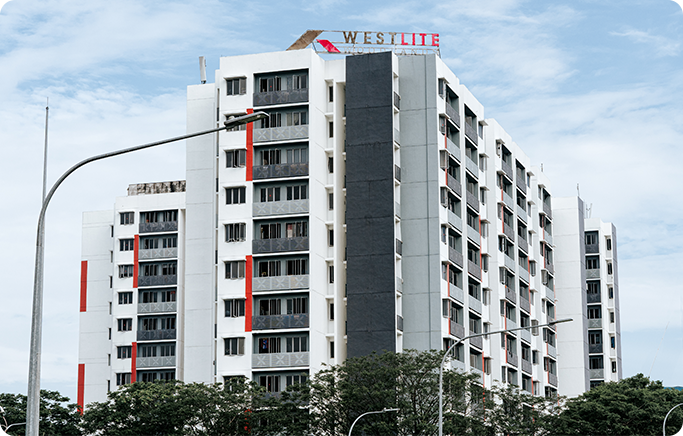
The portfolio numbers as reported — 28,266 operational beds across 15 properties in seven cities and three countries — capture the current run-rate but understate the structural pipeline. Westlite Toh Guan now holds total capacity of 9,094 beds (including the new block of 1,764 beds that received its FEDA licence in December 2025, plus 664 retained beds under Toh Guan Expanded Capacity that secured FEDA licensing in March 2026). Westlite Mandai sits at total capacity of 9,986 beds (the 3,696-bed new block received Temporary Occupation Permit in January 2026 and FEDA licensing in March 2026, plus 1,980 beds retained under Mandai Expanded Capacity for which FEDA licensing remains in progress). MEC carries a S$34.0 million consideration payable when the asset is operational and conditions are satisfied for immediate occupation by 30 June 2026.
Westlite Ubi sits at 2,190 beds total capacity once the new 540-bed six-storey block is delivered. Provisional planning permission was received on 10 February 2026, construction commenced in 1H 2026, and the build period is approximately 1.5 years — meaning delivery in the second half of 2027. Estimated cost of the AEI sits within existing debt facilities. Aggregating across the three assets, the announced capacity stack reaches 21,270 beds before considering Westlite Woodlands and Westlite Juniper — meaningful headroom for revenue growth over the next 18 to 30 months as new beds clear FEDA licensing, ramp through lease-up, and reach stabilised occupancy.
The structural backdrop supports it. Singapore CMP work permit holders rose 5.6% year-on-year to 482,600 as at December 2025, on a 2020-2025 CAGR of 11.0% in CMP sector output versus 5.2% for real GDP. The Building and Construction Authority projects S$47-53 billion in 2026 construction demand. New supply over 2026-2027 is gated at 40,200 beds across five purpose-built dormitory sites, while approximately 102,800 beds across the existing market face lease expiries in 2026-2030 — a non-renewal of any meaningful share of which would tighten supply further. The Dormitory Transition Scheme structurally compresses the share of compliant supply: full Interim Standards by 2030, full New Dormitory Standards by 2040.
The Read
The clean double beat — revenue, NPI, and occupancy in front of prospectus across all three geographies — establishes that the IPO underwriting was conservative. Two consecutive reporting periods of outperformance build a base case that the manager's forecasts are achievable rather than aspirational. But the 1Q 2026 narrative is not really about the 2.7% revenue beat. It is about three distinct decisions made within ninety days of listing.
The first is capital deployment velocity: A$345 million committed to a Sydney PBSA asset entirely through debt facilities, consuming approximately 43% of available debt headroom in a single transaction. That move bought immediate scale and a fixed-income window through end-2027, but the post-2027 lease structure is now the largest single variable in forward NPI, and the related-party dimension of the master tenant means the renewal negotiation will be a governance moment rather than a market test. The second is hedge architecture: the post-quarter-end walk to 71.7% fixed-rate cover — entered between 31 March and 5 May 2026 — signals the manager preferred to lock in financing-cost certainty over retaining float-rate optionality, which is the right read at this point in the rate cycle but does narrow upside if base rates fall faster than the forward curve implies. The third is the PBWA capacity stack: with FEDA licensing now secured for the Toh Guan and Mandai new blocks, the Singapore segment carries structural revenue tailwind through 2026 and 2027 simply from filling beds that already exist on the balance sheet.
The CEO Tony Bin's read on the quarter, framed for unitholders: "results exceeding our IPO projections for the second consecutive reporting period." Two-of-two is a base from which to ask the next question — what does CAREIT look like by FY 2028, when the Macquarie Park master lease has rolled and the PBWA new blocks have stabilised? The answer to that question is what the next four reporting periods will start to define.