Frasers Logistics & Commercial Trust 1HFY26: Reported DPU 2.95¢ (-1.7%) Masks +11.9% Organic Growth As 75% Of Management Fees Taken In Units Vs 43.1% Prior; Capital Distribution From Divestments Down To 0.13¢ With 357 Collins Residual Nearly Exhausted; ATP Ex-Google Backfill At 83% With Full Commencement By January 2027; AU NSW Single Lease Reverts +35.3% — Hapert NL €43M Acquired At 3.3% Discount To JLL Valuation
FLCT's 1HFY26 results, released 5 May 2026, read clean at the headline: revenue +2.8% YoY to S$238.9M, adjusted NPI +3.6% to S$167.0M, DPU of 2.95 Singapore cents at an annualised yield of 6.6%. Underneath, three deliberate manager choices are doing more…
Frasers Logistics & Commercial Trust's 1HFY26 results, released 5 May 2026, read clean at the headline — revenue +2.8% YoY to S$238.9M, adjusted net property income +3.6% to S$167.0M, distribution per unit of 2.95 Singapore cents at an annualised yield of 6.6%. Underneath, three deliberate manager choices are doing more of the work than the operational growth implies, and the question for FY26-FY27 is what happens when those choices either reverse or normalise.
The headline DPU of 2.95 cents is down 1.7% from 1HFY25's 3.00 cents — but that comparison flatters the operational performance because it is dominated by a step-down in capital distributions from divestment gains (S$5.0M in 1HFY26 vs S$17.99M in 1HFY25). On a like-for-like basis, DPU before capital distribution rose 11.9% from 2.52 to 2.82 cents, the cleanest signal of underlying growth in the print. Reading the print as a -1.7% DPU year — as the surface number invites — gets the structural picture wrong.
What is harder to reconcile is the gap between distributable income before capital distribution (+12.5% YoY) and adjusted NPI (+3.6% YoY). Two manager choices explain most of it: 75.0% of management fees were taken in units in 1HFY26 versus 43.1% in 1HFY25, suppressing the cash outflow that funds distributions; and the recently-completed €43.0M Hapert acquisition was structured to be fully debt-funded against unused facility headroom, with a 3.3% discount to JLL valuation. Both are defensible — neither is a substitute for organic NPI growth.
This piece walks through the four moves we think matter beyond the headline: the management-fee scrip flip and what it tells us about manager priorities; the divestment-gain capital distribution normalising in real time and what 1HFY26's 0.13-cent contribution implies for 2HFY26; the Alexandra Technopark ex-Google backfill landing at 83% with full commencement now mapped to January 2027; and the geographic split inside the +9.4% L&I rental reversion that puts NSW at +35.3% on an incoming-vs-outgoing basis while Singapore commercial prints negative.
📊 The 75% Management-Fee-In-Units Flip Is The Year's Most Under-Reported Number
FLCT's REIT manager elected to take 75.0% of 1HFY26 management fees in units, up from 43.1% in 1HFY25. The decision is disclosed in passing on slide 7 of the results deck and footnoted in the press release distributable income table. It deserves a closer look than either gives it because it materially affects the comparability of the year-on-year DPU print.
The mechanic: management fees that are paid in units are non-cash from the trust's perspective, which means they do not reduce cash distributable income. When the manager takes a higher percentage of fees in scrip, distributable income is mechanically higher — without any change in operating performance. The difference between distributable income before capital distribution rising +12.5% YoY and adjusted NPI rising only +3.6% is partly explained by this fee-payment structure shift. Strip it out and the underlying organic growth in distributable income would be materially closer to the +3.6% NPI print than the +12.5% headline implies.
The trade-off is that fees taken in units dilute existing unitholders by issuing new units at the prevailing reference price. With FLCT trading at S$0.895 on 31 March 2026 and NAV per unit at S$1.12 — a P/NAV of 0.80x — units issued for fee settlement are dilutive at NAV but accretive at market. Whether the manager should be taking fees in units at a discount to NAV is itself a governance question: in periods where the discount is wide, scrip fee settlement transfers value from existing unitholders to the manager unless the manager is buying the units back later or the discount closes. The 75.0% election is the highest run-rate election of fees-in-units in FLCT's recent history; the 43.1% prior-year reference is meaningfully below it.
The forward read: this is a reversible lever, not a structural earnings improvement. In 2HFY26 the manager could elect to take fees in cash again, in which case distributable income would step down purely from the structure change. The election ratio is itself a forward signal — if the manager continues at 75% or higher into 2HFY26, it suggests a posture of supporting headline DPU through unit issuance; if it normalises back toward the historical 40-50% range, the resulting distributable income compression will be optically painful even with stable operations underneath.
📉 Capital Distribution From Divestment Gains Is Normalising — 0.13 Cents Tells You Where The Run-Rate Is
FLCT's reported DPU split for the last three half-years tells a clean story:
1HFY25: 2.52 cents organic + 0.48 cents capital distribution = 3.00 cents total. 2HFY25: 2.69 cents organic + 0.26 cents capital distribution = 2.95 cents total. 1HFY26: 2.82 cents organic + 0.13 cents capital distribution = 2.95 cents total.
The capital-distribution component has compressed from 0.48 cents to 0.13 cents over twelve months — a 73% reduction — even as the organic component has grown 11.9% over the same period. The trust is running out of accumulated divestment gains to top up distributions; the deck explicitly footnotes the 1HFY26 capital distribution at S$5.0M (vs S$17.99M in 1HFY25, -72.2%). The S$5.0M in 1HFY26 is a residual from the September 2025 divestment of 357 Collins Street; once that residual is exhausted, capital-distribution top-ups go to zero unless a further divestment is executed.
What this means for 2HFY26: if the manager continues the current trajectory, capital distribution likely steps to zero or near-zero, and reported DPU collapses to whatever the organic component delivers. At 2.82 cents organic in 1HFY26 with positive +11.9% trajectory, 2HFY26 organic could land at c.2.85-2.90 cents, but the absence of a top-up means total reported DPU could print 2.85-2.90 cents — the lowest half-year DPU since the merger with Frasers Commercial Trust. That would be a +0% to -3% reported DPU print on what is genuinely a +13-14% organic growth year. The optics will be ugly even if the operations are clean.
The structural answer would be a further divestment to replenish the capital-distribution pool. The Australian commercial portfolio — particularly the trust's office assets which sit at 4.8% of AUM but face structurally elevated vacancy in markets like Perth (16.9% headline CBD vacancy) — is the natural source. The 357 Collins Street precedent (sold September 2025) is the template. A 2HFY26 or FY27 divestment from the commercial book at gain to book would reload the capital-distribution mechanism; absence of one will leave the DPU optics exposed.
🇸🇬 Alexandra Technopark Ex-Google Backfill: 83% Leased, Full Commencement Maps To January 2027
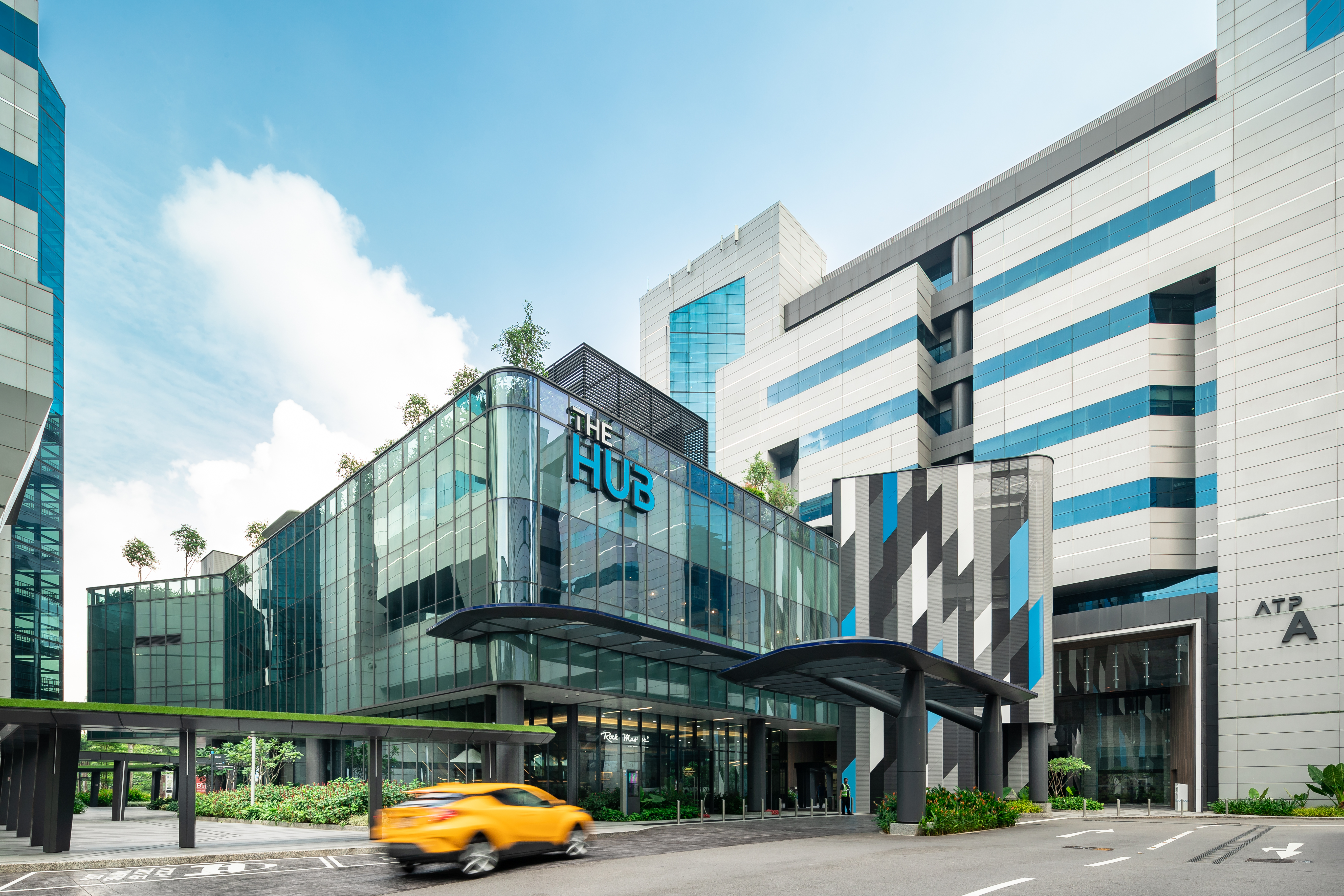
Alexandra Technopark is FLCT's single largest commercial asset by value (S$719.3M, 10.3% of AUM) and the most-watched leasing story in the portfolio since Google's 2024 vacate. The 1HFY26 deck reports 83% of the ex-Google space now secured through committed leases — flat from 31 December 2025, but with the deck explicitly disclosing that the 85.6% reported occupancy at 31 March 2026 falls to 75.1% if committed-but-not-yet-commenced leases are excluded.
The 9.7-percentage-point gap between reported and in-occupation occupancy is honest disclosure and the right framing. By January 2027, all committed leases will have commenced — meaning the in-occupation occupancy will converge upward to the reported figure. Until then, the trust collects rent only on leases that have crossed their commencement date; everything else sits in a contracted-future pool that flatters reported occupancy without yet flowing through to NPI.
The Singapore commercial book in 1HFY26 was a genuine drag on the period. The deck attributes part of the YoY revenue softness to "higher vacancies in ATP and FBP" — Alexandra Technopark and Farnborough Business Park together represent c.13% of portfolio value and both ran below 90% occupancy through the period. ATP rental reversion in 2QFY26 was -1.2% on an incoming-vs-outgoing basis (Singapore commercial line, +0.8% on average-vs-average, both for 1,851 sqm across three leases). The negative reversion is small in absolute terms but signals that the manager is taking modest rate concessions to secure backfill commitments rather than holding out for higher rents at the cost of further vacancy.
The forward question: when the committed leases commence through calendar 2026 and into January 2027, does NPI step up materially or has the manager underwritten the backfill at rents that simply replace the Google contribution dollar-for-dollar? The deck does not disclose the in-place rent on commenced ATP leases versus the rent assumed for committed leases, so the magnitude of the income step-up remains uncertain. What is certain is that the optical "ATP at 85.6%" will look better through 2026; what is not certain is whether the underlying rental income compounds or merely catches up.
🇦🇺 The +9.4% L&I Reversion Headline Hides A NSW At +35.3% — That's The Embedded Growth Signal
The 1HFY26 portfolio rental reversion of +9.8% on an incoming-vs-outgoing basis (and +26.2% on an average-vs-average basis) is comfortably above the 1HFY25 trajectory and supports the +11.9% organic DPU growth narrative. But the geographic decomposition matters more than the headline.
2QFY26 logistics & industrial reversions by market: Singapore Tuas South negligible (1,780 sqm with no comparable). Australia Queensland +2.4% / +7.0%. Australia New South Wales +35.3% / +71.7%. Australia Victoria +3.0% / +13.9%. Germany Leipzig/Rhine-Ruhr +3.9% / +17.0%. Netherlands Venlo +2.1% / +21.9%. The L&I total: +9.4% / +23.2%.
The NSW print is the standout: a single 24,625 sqm lease delivered an incoming rent 35.3% above the outgoing rent and an average rent 71.7% above the preceding average — including contracted step-ups and CPI indexation over the lease term. This is the JLL-tracked Sydney Outer Central West rental dynamic showing through to FLCT's portfolio: prime grade rents in that submarket grew 3.4% YoY to A$232/sqm by 1Q 2026, but lease terms signed today reset rents from leases originally inked at the 2018-2019 vintage of A$117-130/sqm. The mark-to-market on legacy leases is the structural growth story, and Sydney is where it sits in starkest form.
The pattern repeats — at smaller magnitude — across the rest of the AU portfolio and into Europe. Germany's +3.9% incoming-vs-outgoing on Leipzig and Rhine-Ruhr deals translates to +17.0% on an average-vs-average basis once contracted CPI indexation flows through. Netherlands Venlo's +2.1% becomes +21.9% on the same basis. The European leases are CPI-linked — at the current ECB inflation target of 2% with prints running 1.9-2.4% across the FLCT footprint markets, the indexation mechanic continues to drag rents upward at a contracted rate without manager intervention.
What this means: the trust's L&I book has structural rental growth embedded in two layers. The first is mark-to-market on legacy lease expiries — most pronounced in NSW where the 2018-2022 lease vintage is rolling at 30-70% above original signed rates. The second is contracted indexation on existing leases — running at 3-3.5% per annum in Australia and CPI-linked in Europe (typically 2.0-2.5% currently). These two layers have a multi-year runway before they exhaust. The +9.8% portfolio reversion is the visible expression of layer one; the embedded indexation in 85.1% of portfolio leases is layer two compounding silently.
🌍 Hapert Acquisition Geometry: €43M, 3.3% Discount To JLL, Fully Debt-Funded At 34.4% Pro-Forma AL
The Diamantweg 26 Hapert acquisition completed in April 2026 is small in absolute terms (€43.0M, approximately S$64.1M, against a S$7.0B portfolio) but informative on three dimensions: pricing discipline, structuring, and strategic direction.
The asset is a 25,603 sqm modern freehold logistics facility, 100% leased to DSV Air & Sea Nederland B.V. on a 9.5-year WALE, with an A+++ Energy Performance Certificate. Pricing was €43.0M against an independent JLL valuation of €44.45M dated 28 February 2026 — a 3.3% discount to valuation. The deck footnote also discloses the consideration payable, after netting an outstanding rent-free incentive owed to the existing tenant, was €42.1M (S$62.8M). The net effective price is c.5.4% below the JLL mark.
The structuring choice was fully debt-funded. The deck discloses pro-forma aggregate leverage at 34.4% versus the reported 33.7% as at 31 March 2026 — a 70 basis-point step in gearing for a cash acquisition that uses unused facility headroom rather than equity issuance. With S$400M of undrawn committed facilities available against S$242M of 2HFY26 debt obligations, the trust has structural debt-funding capacity for further small-ticket acquisitions without triggering equity issuance. At the current S$0.895 unit price (P/NAV 0.80x), equity-funded acquisitions would be dilutive at NAV, so debt-funding is the rational choice as long as the headroom holds.
The strategic read: Hapert continues the pattern of FLCT's L&I-only acquisitions since the FCT merger. The trust's stated objective of growing the L&I proportion of the portfolio (currently 75.1% by value) is being executed mechanically — small-ticket, single-asset, freehold, high-WALE, blue-chip-tenant facilities at modest discounts to independent valuation. The Hapert tenant DSV is a top-3 portfolio tenant by GRI (2.9% as at 31 March 2026); concentration of leasing exposure to a single covenant is rising as DSV-leased assets accumulate — a manageable risk at current proportions but worth tracking.
The Read
FLCT's 1HFY26 print is operationally clean. Revenue +2.8%, adjusted NPI +3.6%, organic DPU +11.9%, occupancy 96.1%, WALE 4.9 years, aggregate leverage 33.7% with S$2.27B of debt headroom to the 50% MAS cap, BBB+ Stable Fitch rating, and a freshly completed Hapert acquisition at a 3.3% discount to valuation. The L&I segment is doing exactly what it should: 99.8% occupancy, +9.4% rental reversion, with NSW Sydney printing +35.3% on the standout single lease.
The reading-between-the-lines work is on three manager choices that are flattering the headline DPU. First, 75% of management fees taken in units versus 43.1% in the prior comparable — a non-cash settlement that supports distributable income but is itself dilutive at the current discount to NAV and is reversible by manager election. Second, the 0.13-cent capital distribution from divestment gains is at residual levels, with the September 2025 357 Collins Street divestment proceeds nearly exhausted; absent a further divestment, 2HFY26 reported DPU will compress optically even if organic growth holds. Third, the ATP ex-Google backfill at 83% committed but only 75.1% in-occupation has rental income still flowing in over the next nine months as committed leases commence — the reported 85.6% occupancy at 31 March 2026 will compound upward through January 2027, supporting Singapore commercial revenue without yet reflecting in 1HFY26 numbers.
The investment case for FLCT on this print: a quality global L&I portfolio benefiting from genuine layer-one rental reversion in Australia and layer-two CPI indexation in Europe, with a disciplined manager executing single-asset acquisitions at modest discounts to valuation, against a balance sheet with meaningful debt headroom and a BBB+ Stable rating. The risks: the management-fee scrip lever can reverse and compress reported DPU; the divestment-gain capital distribution is now near-zero and reported DPU is exposed; the Singapore commercial book remains a drag on the geographic mix; and the European yield environment (with prime logistics yields stuck at 4.40% in Germany and 4.75% in Netherlands at end-2025) limits acquisition upside on debt-funded growth.
What we are watching: the 2HFY26 management-fee election ratio (whether 75% holds, normalises to 43-50% historic, or steps higher); the timing of any further commercial divestment to replenish the capital-distribution pool; ATP's in-occupation occupancy trajectory through calendar 2026 toward the January 2027 full-commencement date; and whether the manager continues the small-ticket L&I-only acquisition pattern or signals a larger transaction that would require equity issuance.